The program wouldn't own the copyright, but that doesn't necessarily mean that the company which made the program would own the copyright. It could end up public domain.
E.g. the recently infamous selfie by a monkey was ruled public domain, having been produced by a non-human.
I don't get that monkey selfie ruling. If the photographer deliberately gave the monkey a camera to take pictures, shouldn't the photographer be the owner of it? If the monkey isn't a legal entity, why is it considered the creator? If I dropped my camera on the floor and the button got pressed, is the floor now the creator of the image? If I set the automatic-timer function on my camera, is the timer mechanism now the creator of the image?
Doesn't hold up. Library of Babel and the Universal Slideshow would be able to claim copyright on all photographs and literature because all photographs and all literature that ever will be or ever was is contained within their corpus/gallery.
Every picture you've ever taken, the Universal Slideshow already contains that picture. The picture of your birth, every memorable moment of your life, and every possible variation of your death.
Everything is already created. In regards to the Library of Babel, you can even search the library to verify this. (There is an extended Library that contains entire novels to be searched - the web version is a bit smaller/limited to pages.)
It's already there it just needs to be found. That's the entire point!
This is a false claim. The Library of Babel is far from complete; the site itself only claims completion up to 3200-character texts. And that's limited only to lower-case alphabetic letters, periods, commas, and spaces. So there is still a vast amount of possible texts that haven't yet been created.
Irrelevant. It includes numerous works within those constraints that would ordinarily be subject to copyright. I tried it with a variety of short poems I know, both in and out of copyright, so there's more than enough amterial here for a test case, even though it doesn't include all possible material.
The Library of Babel that is online has those limits, yes. Which is why I explicitly mentioned I wasn't referring to the website.
>(There is an extended Library that contains entire novels to be searched - the web version is a bit smaller/limited to pages.)
The creator has variations of the code that aren't online. For example, lower-case alphabetical letters was a choice to "remain true to the original concept" but a base64 variation that allows for capital letters is possible. Furthermore - searching for entire books rather than being limited to 3,200 characters is also possible. Also other languages would also be possible but require further variations of the code.
It's just having this work on the web to a website that sees 30-40k daily visitors because the algorithm isn't fast enough to meet those demands.
Rate limited in posts. My reply to the below is as follows:
Your claims only hold for the web version. I was not speaking of the web version. So you are explicitly wrong. There is a version of the library that is not limited to those characters, that is not limited to lowercase Latin alphabet, and is not limited to being searched 3,200 characters at a time. So what are you contending by making such statements?
Yes. The web version is held to those limits. Which is why I explicitly mentioned I was not referring to the web version. Your claims only hold against the web version. So I'm not seeing the point you are trying to make here.
E2:
I hate how HN rate limits like this. :)
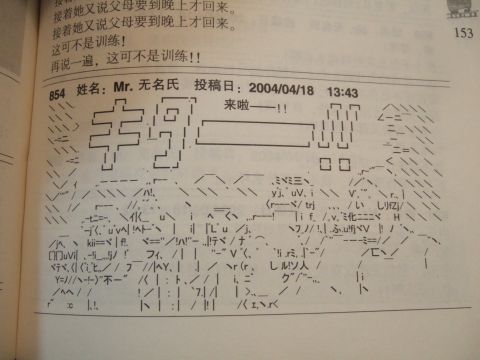
I'll concede that. Does ASCII art of a Chinese character represent the same information as the Chinese character? That's stretching things so I'm not making that as a counterpoint - but more of a thought experiment.
I'm not challenging the claim that it contains a lot of texts; I'm challenging the claim that "everything has already been created and just needs to be found." That claim is explicitly false, regardless of the version of the Library of Babel you are using.
Edit: Reply to your reply:
One inherent limitation with the current code is that it has to assume some encoding. Currently, there is no encoding that contains all known glyphs (e.g the Prince symbol, uncommon kanji, etc) so there will be texts that can not currently be generated, regardless of how much you increase the character set.
Edit2: Even if one were to allow ASCII art to represent a character, you then have the problem of how to distinguish between ASCII art substitution and actual ASCII art. Consider "Densha Otoko," which basically consists of message board posts that often contain ASCII art.


E.g. the recently infamous selfie by a monkey was ruled public domain, having been produced by a non-human.
https://en.wikipedia.org/wiki/Monkey_selfie