The paranoid in me wonders if in the future we'll have to resort to projects like this for sensitive tasks to know our hardware hasn't been backdoored...
There's some serious head scratching going on when you watch the video. If you can, wait a day before watching the explanation. I'm not even sure what's going on after watching that!
Speculating: Yes, but it's probably a bit harder to make a backdoor in an FPGA that can anticipate and manipulate a custom design. The backdoor would have to be smart enough to know it's running a CPU, although if it could just detect that it's running multiple Ethernet ports, it could still act as a silent forwarder for evil packets or a data mangler. It could conceivably also try to send the FPGA design to the backdoor's owner for them to tell the backdoor what to do next.
Yes, the fab could put in a backdoor. That's why you need to build your own. But, what if the machinery you purchase has a backdoor? Now you need to build your own fab machinery! It's backdoors all the way down. There always has to be some level of trust.
Doesn't really matter, though. If you have to build your tools up from that level, it's going to cost so much that only governments and huge corporations can do it--and those are exactly the people installing the backdoors in the first place, so we're back to square one.
> The paranoid in me wonders if in the future we'll have to resort to projects like this
This has got me picturing my store-bought laptop with monstrously large, homemade processors bursting from the case that I can use for sensitive tasks. I wonder how close this is to the realm of possibility.
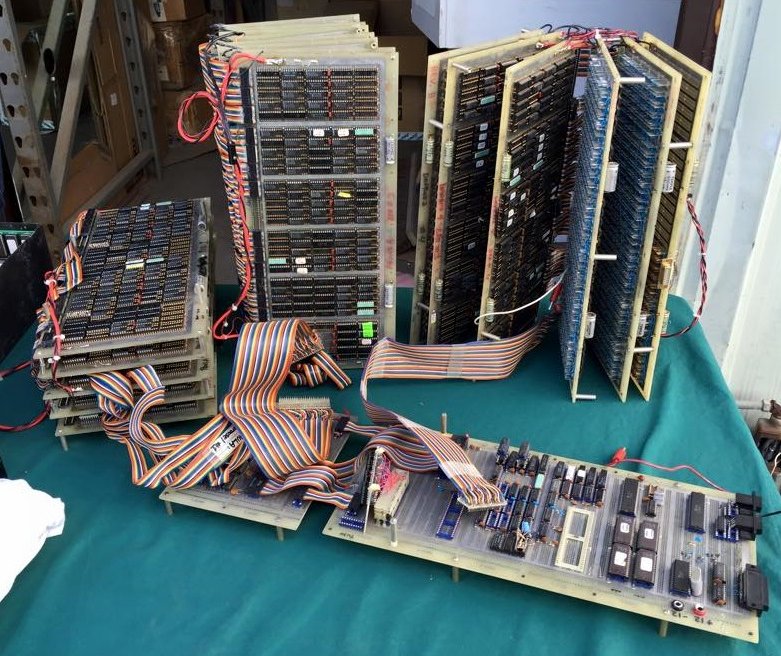
Well. Having seen photos of the original Amiga prototype, as demoed at 1984 CES (hidden under a table). Each breadboarded custom chip was about twice the size of the machine case. Used about 7200 logic chips, so maybe not enough paranoia proofing? The 68000 was, of course, standard.
I'm sure a Radeon and i5 would only be a bit larger. The internet may be obsolete by the time you're done wiring. ;)
Hadn't see the pictures of the Lorraine prototype before. The article you linked refers to breadboards but that's not what is shown on the picture and it's unlikely that much more than very basic concepts were built using breadboard.
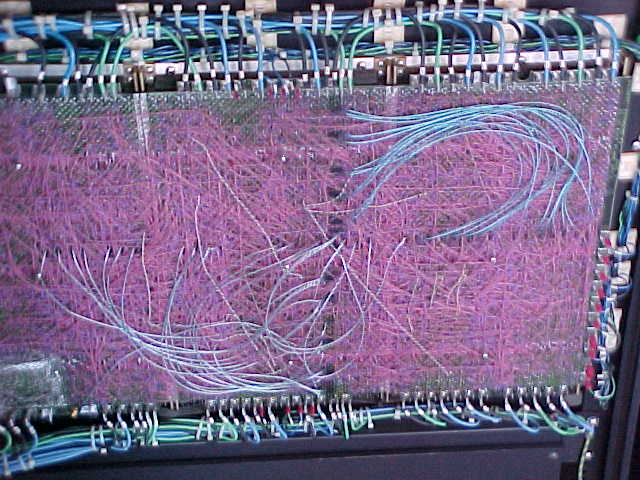
Instead people would use wire a much more reliable technique for building prototypes and very low volume productions.
Wire wrapping involves boards with pre-drilled holes in which you insert IC sockets with elongated pins. You then wrap a few turns of wire around the pin and route your wire to another one.
That's what we see in the picture and others of the same prototype.
I think it's hard to be amazed enough at projects like the Amiga. Custom chips prototyped with discrete logic and a complete multitasking OS - all built from scratch.


The paranoid in me wonders if in the future we'll have to resort to projects like this for sensitive tasks to know our hardware hasn't been backdoored...