It's fascinating how you can see other manufacturers' production designs hidden among these prototypes, too. It makes it pretty obvious that although some designs are obvious, where most companies design a product, produce a prototype, tweak it and send it to manufacturing, Apple designs a product, produces a prototype, tweaks it, sends it to manufacturing, then takes a look at the finished version and gets ready to start over from scratch if it isn't perfect.
It almost lends some credence to Apple's claims of trade dress infringement that have been so widely mocked. Most manufacturers released their own take on a smartphone to not much acclaim before settling on something very like an iPhone. Apple cries foul, to which the gadget using populace replies, "Come on, this is obvious-- there's only so many shapes it could be. Quit whining."
So Apple goes, "Yes, and it took us forty-five revisions to figure it out. It took our competitors two. It's almost as if they had some help, isn't it? Do you really think it's easy to work out the exact shape that something should be? Do you think it's free?"
Not saying it's clear cut, but it's swayed me quite a bit in their direction.
If you don't think other manufacturers have dropped designs, you're fooling yourself. The difference is that Apple makes only product at a time, so other manufacturers can experiment at bit with different designs, whereas Apple can only release one of their designs. When other manufacturers drop a design, it's not dropping a design, it's dropping a product.
(The document is pretty amusing in general: "Design was not the only thing Apple took from other companies in developing the iPhone. While Apple touts itself in the popular press as a company of 'firsts,' it recognizes the opposite internally. As Apple admitted in internal emails, Apple was not the first [redacted] [Redacted] Ex. 4 (DX 578). Nor was it [redacted] Id. Indeed, as one Apple employee explained to an overly enthusiastic marketer, [redacted] Id."
I love the idea that Apple's internal emails actually make frequent use of the word [redacted]. Like, "Hey, has anyone seen my [redacted]? I think I might have left it at a [redacted]. Hopefully that [redacted] reporter doesn't get his hands on it.")
That image is really underwhelming considering what Apple has released. Apple actually gave us a peak into their design process. I really want to see Samsung's now too.
That's an interesting point. I don't think it makes a small difference, though-- in particular, there's a perverse incentive to spend money marketing something you know isn't perfect rather than on making it better. But I guess that's just the story of Apple v. The Industry.
There are a whole heap of 'un-released' samsung prototypes as part of this legal case too (here just a few versions of one phone from 2006: http://www.groklaw.net/images/Samsung-1.jpg ) - many more variations of other phones where produced the in the same style.
Don't be tricked by the Apple produced image showing the phones that Samsung released before the iPhone - that is not all they (and many other manufacturers) were working on. Motorola A1000 (http://www.heise.de/altcms_bilder/62452/3_hires.jpg ) came out long before the iPhone - and followed many of the same conventions.
The Motorola A1000 didn't really follow the same conventions as the iPhone. For one, it used a stylus, and had 6 face buttons.
The iPhone has one face button. Most Android devices initially had buttons for call-related functionality, though most manufacturers have dropped that for either software buttons in the UI or static capacitive "Buttons" on the bottom of the device. The only similar convention that the Motorola follows as the iPhone is that the touchscreen is the primary input device.
I was talking purely on the hardware, as I'm not familiar with the phone enough to comment on the software. But from that perspective, you definitely are right, a lot of "modern" OS features in for the default iOS and Android shells are in that phone.
I agree in part with your assessment in that I can see that being the way Apple could think. I'd like to disagree with that viewpoint, though.
Many of the design concepts Apple tried are obvious as well, and have been implemented before. There's the squared-edge design, the round-edge design, and the multicolor front design. There's also an octogon-edge design (for some reason), which is non-obvious and would be noticeable if copied. All the other differences are on the back (where every vendor is different anyway) or in button placement (where every vendor is different anyway).
Apple went through 45 revisions quite possibly because they had never designed a phone before. And when they did settle on a design, they picked round edges and a screen that takes up most of the front minus room for a button and a speaker. That's hardly the most original design they put into concept. It's no surprise Samsung can easily make a smartphone casing, they could just pull out the specs from their Palm OS 4 devices.
The question is, why didn't Apple make the iPhone look like the iPod Mini? That was a seriously cool and original case. Now Nokia is making the same design.
If the designs were so obvious, why did every phone prior to the iPhone look like crap, and almost every phone since its release looks like a clone or at the least a close sibling?
Yeah, I'm mostly with you-- I'm not totally convinced myself, but I can see where Apple is coming from with all of this.
Of course it doesn't necessarily do anything to refute the obviousness objection. I suppose it's just it makes it a little easier to believe that maybe these things weren't quite as obvious before somebody did it.
Are you even aware that Apple is only releasing this in the first place to prove that Apple didn't copy design from the Sony Style, which is identical to the iPhone but older?
Depends. Are you talking about the SONY-branded "Sony-style" prototype produced at Apple in response to Sony's redesigned Walkman? (Which, so we're clear, did not look like any Sony phone on the market at the time?)
Right. Did you see the part where Apple produced a "Sony-style" mockup[0], complete with SONY branding, that most resembles the iPhone 4? There was never a Sony Style.
That would be Samsung's claim, and thus the release of other, earlier mockups from Apple which more closely resemble the eventual iPhone. And again, Samsung's claim is based on an interview with a Sony designer about a product[0] which looked nothing like an iPhone, which inspired Apple to produce one mockup merging one of their existing designs with Sony design elements. It is not based on any Sony product.
Despite what I've been saying here, I'm not an Apple partisan, but come on-- this is totally ridiculous.
Of course, I don't really think that, I'm sure they spend a great deal of time and effort on design. I was just struck by how many of the designs Apple thought were almost good enough to sell other companies took a look at and thought, eh, close enough.
this doesn't cut it for me. In my (maybe too simple) vision, Apple just spends more time and more money than other companies. Why? In order to get greater profit at the end of the run. Does that give them the right to sue companies that do not follow that path?
I think maybe the point is that we have a system (patents) for protecting the investment that companies make developing nuts-and-bolts technology, but we don't really have a system to protect the very real investment that a company makes finishing and iterating on a design.
After speaking to a lot of friends about this, this really depends on whether you put value on design work. As an engineer, it's easy to dismiss stuff like the design work without realizing how much time and money is spent prototyping and refining this stuff.
There's not a lot of debate about how Samsung build consumer products - shamelessly copy the guys who sell more than they do, and combine that with really solid engineering. It's sort of the best of both worlds for the consumer, until of course the guys who were doing the design work go out of business (ie Motorola) and we're stuck with really uninspired design again.
It would be kind of silly to protect the iteration of a design, though. While there are lots of potential shapes for things, there are only so many that are reasonable from a production and engineering standpoint (which is probably covered under some variant of Moore's Law), but still.
Point being, it's reasonable to protect released products, but if we protect everything in the concept stage that's never released, then it would be ridiculously easy to iterate on all possible shapes for a cellphone and lock it down as a potential design, which would then prevent everyone else from creating a cellphone that had a shape.
Haul that into court and say "Oh, yeah. We designed a phone that was trapezoidal on Feb. 3, 2015. Never released it, but those other guys are definitely copying our design."
For me it's the opposite. All those phones look basically the same, except with slightly different corners and colours. Form follows function in this case, I think.


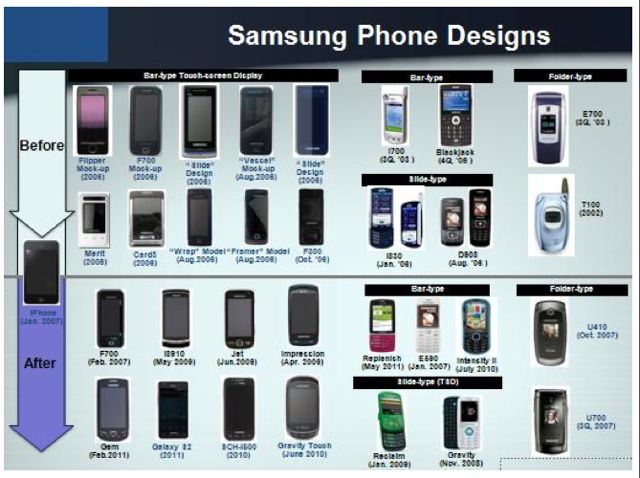
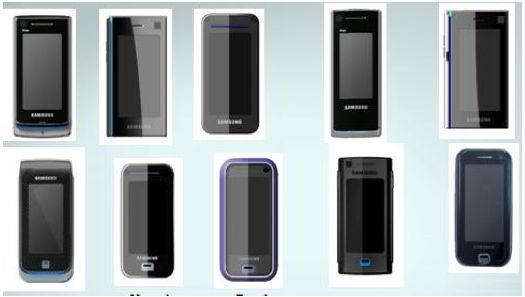

It almost lends some credence to Apple's claims of trade dress infringement that have been so widely mocked. Most manufacturers released their own take on a smartphone to not much acclaim before settling on something very like an iPhone. Apple cries foul, to which the gadget using populace replies, "Come on, this is obvious-- there's only so many shapes it could be. Quit whining."
So Apple goes, "Yes, and it took us forty-five revisions to figure it out. It took our competitors two. It's almost as if they had some help, isn't it? Do you really think it's easy to work out the exact shape that something should be? Do you think it's free?"
Not saying it's clear cut, but it's swayed me quite a bit in their direction.