I think there is a bit of wider social norms piece missing as well on AI use in knowledge work context.
Someone forwarded an enormous amount of text over teams the other day at work. From someone (bless her) that always means well but usually averages about one spelling mistake per word and rarely goes over 20 words per message. Clearly copy paste chatgpt.
For say hn gang that thinks in terms of context shifts, information load and things on THAT wave length the problem with that situation is obvious but I realised then that is not at all obvious to the average public. She genuinely seemed to think she's helping me by spending 15 seconds typing in a prompt and having me spend the next 30 minutes untangling the AI slop.
There is zero understanding or consensus of acceptable practices around that sort of thing baked into societal norms right now.
Seems AI has made it cheap to produce information but now you have to spend more time parsing the information. And it’s now the less competent/useful people spending less time producing more information with the more useful people spending more of their valuable time parsing that information. This is why I’m skeptical of LLMs ever becoming a net benefit in most organizations.
That is pretty much my existence at $MAJOR_TECH_COMPANY now. Inexperienced security engineers running bots against my codebase and sending me pages long tickets with their "findings". There might be a couple of interesting nuggets here and there but by and large the reports are just noise. This churn is actively taking away from my ability to actually respond to customer-impacting issues because "security is always our top priority".
Well, you can use LLMs to parse LLM-generated slop. They make nice summaries. I have taken this approach to people who send me obviously generated LLM text; I simply run it through an LLM, paste the summary, and ask them "Is this an accurate summary?" and then I ask the for their original prompt.
They're getting paid to encode some inane prompt into paragraphs of text, and then they're getting paid again to summarize that back into something with even less value than the original prompt. And they're making money hand over fist because people are happier to play that game rather than just pushing back on the jerks sending them pages of generated garbage in the first place.
I would agree with you, except right now the walls of text come from people using the free or very cheap versions of ChatGPT, et al. So there's not even anyone making money off of it.
Ah yes, take my single sentence, blow it up to 3 paragraphs with LLMs, and then the person reading it can have an LLM summarize it in a single sentence.
We're so close to realizing the answer was with us the entire time.
midwit meme template
guy on left: katie u want meet 3pm discuss project
midwit: Hi Katie, I hope this message finds you well and that your week has been off to a productive start. I wanted to reach out and proactively touch base regarding an opportunity to align on some of the ongoing project-related workstream...
guy on right: katie u want meet 3pm discuss project
Agreed that just step 1 or step 1 and 2 would be depressingly pointless, but step 3 and 4 make this the equivalent of sending someone a let-me-google-that-for-you kind of link, does it not?
Caught out like this I imagine many people will kind of get the fact that you'd rather have their direct inputs..
Worse still, the person that is the most egregious about doing this seems to appreciate it and responds with "Yes, that's right!" and just ignores (or has no idea what I'm talking about) when I ask for the original prompt.
I simply ask for a positive affirmation of the summary so that I can act on that, instead of other things.
The thing is, eventually these products will be more integrated into business workflows and have access to all the context, so the three paragraph expansion probably will be a significant improvement upon the original input.
And either that person won't be employed anymore, of the thing they were asking for in the first place will be automated for them.
I've already got my agent building a dossier for everyone we interact with. I haven't started training it on their writing style so I can mirror back to them... yet.
Oh I know. In the past month I’ve moved several thousand dollars in spending away from companies that turned their support into a useless understaffed AI program.
The disease has spread to six figure enterprise contracts hallucinating about their own APIs.
My employer already records every scrap of communications, I'm running everything on corporate infrastructure, and they sent the information to me.
Giving the AI knowledge of the org chart, who works on what, how they prefer to communicate, what their goals/biases are, is no different than what every ape implicitly collects in their own head.
As these products improve, one person sending the output and not the prompt will remain useless. The prompt captures the intent and level of real consideration of the person sending it, the receiver can augment that with additional information if they want to.
Professional communication has a completely different goal than a student essay, and it's weird you conflate the two. A student paper is useless as an artifact, the actual value is for the student to learn how to write the paper. If a coworker sends me a long email for me to read it should provide some actual value.
I'm arguing against people who essentially say that running the LLM is useless; just send the prompt.. Obviously that is true if the person does zero additional value add, but then that person probably sucked as a colleague before LLMs anyway. When you use an LLM agent correctly you are adding value beyond just the prompt, and those three additional paragraphs won't just be extra noise. Especially if the agent is automatically fed your personal context.
An essay states a hypothesis and then uses first and second party sources to validate it. I'm not conflating anything, it's just a good abstract example of the type of knowledge synthesis work, which is why we make kids do them.
A business strategy proposal is nothing more than a specific type of essay where the research sources are internal research results, market trend analysis, etc.
A technical design doc is an essay about the best way to implement a feature.
An "executive summary" is just an abstract, and the MBR puts the latest research citations and raw results in bullet points.
> When you use an LLM agent correctly you are adding value beyond just the prompt, and those three additional paragraphs won't just be extra noise.
So send me the prompt and the three extra paragraphs that you wrote. The improved LLM will generate the additional context for me if I need it. But heck, maybe I wrote that context myself or have read it many times and don't need it parroted back to me.
> I've already got my agent building a dossier for everyone we interact with. I haven't started training it on their writing style so I can mirror back to them... yet.
have you asked these people how they feel about this? have you asked them for permission, for their consent to do this with their communications to you?
what you’re doing sounds incredibly creepy. like, meta/facebook kinda of creepy. granted, it’s at a more limited scale, but it’s still creepy af dude.
fwiw, if i was your colleague and you asked me how i felt about you doing this with me, i’d be seeing about getting HR involved.
Um, I absolutely expect my colleagues to update their internal model of me every time we communicate, to a greater or lesser degree depending on how much that communication deviates from their expectations, or how much new information it contains. In fact, that is essentially the purpose of communication.
Do you think you are not constantly being "influenced" to do what people want from you?
What do think happens during a peer review or promotion decision?
What do you think the pile of data in SharePoint / GDrive represents?
You think HR will care about someone taking prolific detailed notes at work?
I did phrase my comment in a glib way to draw out this type of reaction. But this type of stuff is what "intelligence augmentation" will include, and the corporate panopticon is already alive and well anyway.
their mental model. the human being’s mental model. the one in our private head. not some model on a corporate server, some secret “dossier” on every interaction you’ve ever had with them. you’re basically creating your own black book / surveillance tool on everyone you interact with dude.
just because the corporations do this to us doesn’t make it okay to do it to each other. just because your employer does it doesn’t mean it’s okay to do to your co-workers. like, there has to be a degree of trust between colleagues dude.
compiling a record of every single thing anyone has ever said to you, an individual human being who is not a corporation or a machine, all for the purposes of “it makes my emails better” is just plain fucking creepy.
i think you might need some time away from the screen. seriously.
> i did phrase my comment in a glib way to draw out this type of reaction.
maybe, just maybe, it would be a good idea to take a bit of time to seriously think about why being glib about this super creepy thing you’re doing is not a good thing.
bit of self-reflection. the thing us humans are supposedly still capable of doing and the machines are not.
does that make it morally okay to do with your colleagues?
like, jfc, these are fucking people were talking about building “dossiers” of. people the person works with where a degree of trust and bonding is necessary. people they probably spend at least a quarter of their waking hours interacting with.
and your defence for it is “well, google does it”.
the best engineers know what not to build. they don’t build every single thing under the sun because they can.
also, don’t you have to explicitly agree to google’s terms for that stuff to use their services?
Nice article!
I wrote something similar this year too after seeing the 5-bullet-points of information stretched out with AI homologous slop too many times.
My default is that I won't copy and paste anything that's AI generated in communications. I kind of think that's the line. Use whatever you want in the background, but I want to communicate with the synthesis of your thoughts.
I think this is a reasonable standard to hold, otherwise, like many before have said...send me the prompt. It's actually more interesting/better I know a coworker is struggling to communicate about something.
I actually regularly used emdashes in my writing —- my kids complain I write like AI in fact — and now I have to consciously remove them.
Likewise, I often used literary flourish and pleasantries like that above article about email decompression; I’m from the south so I think structured formality comes with territory.
I do think using LLM to turn notes and bullets into narratives should be considered no different than rendering CSV text into an excel format, just making it more digestible by recipient.
That’s my latest joke — that we’ll have to pretend like we used the tools so they can feel validated they’ve spent all this money on hyped up technology. So, yes, it’s em-dashes and “it’s not just this, it’s that …” so they can hopefully leave us alone.
I remember feeling embarrassed one time that I used a very early GPT thing to help organize perf reviews for employees from the various bullet points I had written for each (I had a lot of direct reports). But in current world, I assume I’d be praised for doing so.
I will generate an LLM output that organizes scattered information and thoughts, resulting in 1.25x the text. I then read and edit it, generate executive summaries, and send it.
It saves effort for me in organizing, formatting and summarizing, and the LLM is producing more structure than content.
> I often send out the LLM version, but still check if it contains the original thoughts correctly.
Please don’t do this. You probably aren’t aware of how bad this can land. It’s not just about containing your original thoughts, it’s about the verbosity, repetitiveness, and absurdity of it all.
Grammarly is a much better tool for these kinds of purposes, and it actually guides and teaches you to improve your writing along the way.
It's the nature of the product itself. It's a key logger software. That's literally what it does -- take every input on your computer and route it to their servers.
It installs itself as an accessibility tool, which requires special user permissions. With these permissions, it sees literally every keystroke you make (except, in some cases on some OSs, system password prompts). The visual indicator is just their UI.
Regarding "honeypot" -- that's also what a honeypot is. They provide a service you want, then collect data. We have to take their word that they're only using this data to train their AI (which, btw, they are upfront about -- they log everything and feed it into their training. it's in their TOS).
Isn’t a honeypot some decoy website / service / whatever that presents itself as legit, and then once you register / interact with it you’re caught in whatever they want to do?
Eg FBI putting up fake “buy drugs online” sites and logging your info once you place the (fake) order.
It is deception, but it doesn't have to be decoy or fraudulent. It could actually provide the service or deliver goods. The point is that the operator isn't running it for the reason they say they are, but rather to gather info or whatever. Specifically in cyber defense a honeypot is sometimes a fake server that serves as an intrusion detection alarm, but that's actually the odd one out when you look at how the term is used more broadly.
Verbosity and repetitiveness? Which tools are you using?
Tell it that you want a succinct professional email and it will do that. Give it examples of your own writing and it will match that style. If there's something you don't like, tell it to rewrite the part differently.
Theses are literally the things language models are best at.
You don't need a fake extended vocabulary. Just communicate directly and honestly. Underlining spelling errors as you type has been a standard feature of email software for nearly three decades.
The problem is that you lose your voice and adopt one that your audience knows all too well (and knows it isn’t yours). It makes your audience feel like you aren’t listening to them (even though you are!), because they feel like they’re talking to an LLM.
I'm pretty sure most non-native speakers (one here) do the same. I'm not talking about three-paragraph-long Slack thread, but even a single message where I feel otherwise unable to convey what I need _the way_ I want.
My typical practice is to write a reply using my own brain and whatever practices are called for, then attach any interesting chatbot responses that were generated as documents.
So there's a clear separation, a reply from me which I stand by and then some interesting chatbot stuff if you're into that.
You have to call it out when you see it, politely and charitably.
"Hey, thanks! This is a great overview, and I actually asked ChatGPT before asking here and got a lot of the same information, but what I'm really looking for is..."
This is what I do, slightly more explicitly saying “just be the real you”. About 50% of colleagues take it well. The other 50% don’t understand the problem, and don’t understand when (and when not) to use AI.
They are at high risk.
Employees using ChatGPT to renegotiate their salary are showing a serious lack of cognitive awareness.
I like this. I thought to iterate on it a bit, for the folk who respond better to higher-tact phrasing:
"Thanks. I have access to ChatGPT as well. But I ask people for help when it fails. Your thoughts are smarter than GPT's, please provide those, next time."
"If I wanted to receive copy paste from a bot I wouldn't message you, why are you trying to sneak this in?"
You reminded me of American colleagues that lie and say things are good when they are bad lol. Unable to be straight to the point. You're upset at the waste of time yet you thank them?
No, perhaps continental European. When I moved to Britain I had some adjusting period at work because English-speaking countries are terrified of disagreement and confrontation, and I am not used to dancing around the point, especially in stressful settings where efficiency is key. Mind you, I was always polite and respectful to anybody.
I got better at it, but I can’t say I ever got to like the pervasive hypocrisy. To my understanding the American/West Coast is even more fake on this aspect.
Not everyone not conforming to your preferred style of communication is autistic. What is up with the internet trying to diagnose people?!
The parent is right. The reason society as a whole is way too comfortable with overstepping social boundaries, is because people think it’s somehow rude to confront others. It makes no sense. Sometimes you gotta say it how it is, because quite frankly the real rude person is the one copy and pasting a ton of AI output into your communication so you have to parse that and then try and figure out the original intent between the lines. How is that acceptable but saying “don’t do that to me?” is not?
Funny! I'm autistic enough that I went to do it and got 51% German and 27% autistic. In reality am portuguese and never diagnosed (outside of internet comment sections).
> She genuinely seemed to think she's helping me by spending 15 seconds typing in a prompt and having me spend the next 30 minutes untangling the AI slop.
This is the root frustration spreading across workplaces everywhere. Before AI the only way for someone to generate a design document, Jira ticket, or pull request without investing a lot of their own time and effort into producing what you saw.
LLMs came along and erased that assumption. Now you don't know if that e-mail, that 12-page design document, the 100 or 1000 line PR, or those 10 Jira tickets were written by someone who invested a lot of their own time into producing something, or if they had their AI subscription generate something that looked plausible. You have to actually read and process the work, which takes 100 times more effort than it took them to make it.
For people in the working world who saw the workplace as a game of min-maxing their effort against the appearance of being a valuable contributor, LLMs are the perfect shortcut: They can now generate the appearance of doing a lot of work with no more than a few lines of asking an LLM to produce documents.
If anyone spends the 30 minutes to review the AI slop from their 15-second prompt, they'll copy your feedback into ChatGPT and send another document over with the fixes. Now they've even captured you into doing their work for them!
For teams or even entire companies that were relying on appearances of activity as a proxy for contributions, this is going to be a difficult transition. Everyone e-mail job worker in the world just received a tool that will generate the appearance of doing their job for them and even possibly be plausibly correct most of the time. One person can generate volumes of design documents, Jira tickets, and even copy and paste witty responses into the company Slack and appear to be the most engaged and dedicated employee by volume while doing less actual work than ever before.
I think teams that already had good review cultures with managers who cared about the output rather than the metrics are doing fine because anyone even a little bit engaged can spot the AI copy-and-paste employees with even a little inspection. The lazy managers who relied on skimming documents and plotting number of PRs or lines of code changed are in for a rude awakening when they discover the employees dominating their little games are the ones doing the most damage to the team.
> LLMs came along and erased that assumption. Now you don't know if that e-mail, that 12-page design document, the 100 or 1000 line PR, or those 10 Jira tickets were written by someone who invested a lot of their own time into producing something, or if they had their AI subscription generate something that looked plausible.
And frankly the best signal now is: the shorter it is the greater the likelihood it was at least expensive for the human to produce. Said in another way - a shorter thing is easier to make sense of completely and if its garbage - its garbage. At least the cost borne on you was minimised!
> This is the root frustration spreading across workplaces everywhere. Before AI the only way for someone to generate a design document, Jira ticket, or pull request without investing a lot of their own time and effort into producing what you saw.
That’s not really the point. Engineering has always operated on trust networks, not just artifacts.
Your review naturally adapts based on the level of trust you have in the author. If someone has consistently produced high-quality work, whether they used AI or not becomes mostly irrelevant.
What’s funny to me is your last paragraph. A lot of companies are so gung-ho about “AI ALL the things!” that I’m not sure as a manager if I’d get in trouble for “spotting the AI copy paste” junk. I’m supposed to make sure everyone is using AI as much as possible, after all. So, rejecting someone’s output for being low-effort AI slop and asking for a “less AI” version of it might mark me as a silly old fashioned guy who doesn’t believe in AI.
Why not coach the people to use the AI correctly and continue rewriting until it is the correct length and level of detail? This whole thread is full of people talking as if you can only one shot the things, or they are incapable of being succinct.
I've run into a similar thing where I'll be cc'd on support tickets with one of our customer support agents and they'll then reply to me with what is clearly an ai summary of the single email from the customer that I can already read. I do think they're trying to be helpful, but it's hard to not feel like they think I'm a child or an idiot. Back in the day we agreed that Googling something for someone was rude (letmegooglethatforyou.com being a good example), I don't know why ai summaries and slop aren't understood in the same way.
I think it’s related to the same kind of psychology responsible for road rage. When we use a tool enough, we start to perceive it as an extension of ourselves, for better or worse. I think people that use AI to do all their writing or revision have legitimately lost the sense that it’s the output of a tool. They feel like they are helping and don’t see the different between personally writing a message for you or copying the output of Claude to you.
That’s not the intent of letmegooglethatforyou. It’s a pointed way of telling the recipient they should do the bare minimum research on their own before asking someone else for help. It’s not about being angry that someone told you something they found from a cursory google search
You’re right, but Lmgtfy links are incredibly similar in tone to sending somebody ai output.
Lmgtfy was a passive-aggressive (but not really passive) way to say “hey, are you too dumb to google this?”. Sending somebody ai output feels the same to me - the message you’re sending to the recipient is “here, you’re obviously too dumb to ask an LLM about this yourself”. Except some people don’t seem to realize that’s the message they’re sending
letmegooglethatforyou.com was to let someone know that not searching for themselves is rude - it was not because it was rude to search for someone else (it wasn't and isn't)
At a previous position I got frustrated at a manager who'd characterize multiple team members, including myself, I suspect, as "creating AI slop" when he was posting multiple times a week about how his Jira tickets, PRDs etc, were all being "supercharged" (ugh) with AI.
Meanwhile, I was absolutely using AI, but not to write documents but to do first pass critical reviews, the "what am I missing here, what haven't I accounted for here?" but the writing was all my own.
My current bar is “if you know I’m expecting to hear from a person don’t paste unedited ChatGPT outputs and hit send.” Everybody wants to send out the efforts of their corner-cutting, but nobody wants to receive them.
Most people know when they are doing it. If you feel the need to obscure your LLM usage, it means you didn’t put enough of your own voice and work into the final draft and you need to do something about that.
I’d go a step further and say there is never a good reason to share unedited ai output.
The closest acceptable thing to share is the full chat, including your prompts. If the output is useful enough to share, then the human thought process that led to the ai output is almost always more useful than the output itself.
The asymmetry is that lots of people want to use LLMs to produce things, and nobody wants to consume the things LLMs produce.
The Nash equilibrium here is that the market has to find a way for the people producing things with LLMs to pay people to consume them, and the market always finds a way.
That may be the case but every day LLM’s feel less like the next big thing and more like 3D printing. Here to stay, but not nearly as ubiquitous and earth shattering as people made it out to be.
If I had to guess right now, I would say LLM’s are more significant than 3D printers, but less significant than the Internet.
I've thought the 3D-printing analogy is pretty apt for about a year now. It had a lot of promise at first but it never quite has the impact people thought it would. There are still 3D printers for sale, and people still prototype with them, but nobody's printing out a dustpan when they need one.
I think you’re missing the thrust of my comment and the responses. Nobody is saying 3-D printers are worthless, but if you remember what it was like when they were first emerging into the mainstream, you would think we would all have one in our living rooms by now just spitting out everything we need constantly. We would all be building our own furniture and repairing every niche thing in our house with them. We’d all be on some magical network sharing files with each other. We’d have a massive surge in printed guns.
Everything was theorized and it all was a variation of “nothing will be the same for anyone ever again,” not “some specific areas will be really different.”
I'd say that's a pretty accurate analysis. Something that is easily generated by an LLM obviously has low value and there is no moat.
Agentic coding is a bit different, particularly if a great deal of effort and intelligence goes into it, but that's a quite different thing than just cranking out slop apps.
Yeah there is no doubt that some companies are going to radically change their operations because of agentic coding in particular. But the revolution that is being promised, and the investment that has gone along with it, is going to smash against some pretty nasty shoals of reality sooner rather than later
Some are going to radically change their operations, but we have yet to actually see if the ROI on that comes through for them. It will be an interesting thing to watch.
Fair point. My implication (though I completely failed to indicate it lol) is that for some companies it will be a huge, mostly positive change I imagine. But it won’t be the majority of the companies trying to make that happen right now that’s for sure. Unless we want to consider every company deploying a chat bot for user support I guess…though I wouldn’t exactly say that is the massive leap in technology AI is promising
Not quite. Ultimately the lions-share of income of model producer's is coming from firms.
Firms are only going to pay out to model producers if they are getting more in excess of the cost of financing projects over time. If a firm does not see this happen, they reduce their spend on tokens. Simple.
Its a whole lot more nuanced than some shitty game theory.
A lot of time I will just say “Gemini/Claude is telling me…” just like I would for a Google search result. Sometimes helpful to use the common wisdom embedded in the LLMs as a starting point for the discussion.
I also don’t get why people keep saying “who cares so long as it’s correct?”
That’s a huge assumption! And I care a lot, because I want to know a person looked at the result and decided it was correct. If you don’t do that, you’re dumping that work on to me and ignoring that I asked you for a reason.
Anyone can open up ChatGPT and ask for a quick answer. What on earth makes people think I want them to just do that for me when I ask them a question?
And it’s too soon to have these norms. Employers today are willing to part with them at the hint of the slimmest efficiency gains, you’ll waste time. So I think the correct response today is wait for it to settle. Norms will form on their own.
> helping me by spending 15 seconds typing in a prompt and having me spend the next 30 minutes untangling the AI slop.
Only 30 minutes? You have it good! ^_^
This person is creating more work for an FTE who now has both a) the original job, and b) the additional load of purging corruption from the inputs for (a). This is happening at scale.
Your tolerance for this depends on how close to capacity you are for (a). It's a tale as old as corporate time, well-documented by Office Space and Dilbert.
Work is Work. Pantomime is Pantomime , whether it's with "frontier" or low-tier LoLMs.
> There is zero understanding or consensus of acceptable practices around that sort of thing baked into societal norms right now.
What is acceptable right now is to believe that corrupting the inputs to the work of serious FTEs is somehow beneficial. You are expected to sing the revised words of the corporate anthem with your customary passion and obedience. Layoffs will continue until the morale of data centres has improved.
In an ideal workplace, one could sit down with the colleague and have her experience untangling the slop, perhaps by a process akin to pair programming.
Sometimes I wonder if we're letting people graduate from school with no real grasp of the purpose of written communication. School strips writing of purpose, and creates artificial purposes such as using AI to combine words in order for AI to assign it a good grade. Even before the AI era, most human generated text was not worth reading.
Yeah I write prompts asking it to misspell a few words, break a few grammar rules, forget to capitalize once in a while, miss some punctuation once in a while. No one will ever catch on.
> She genuinely seemed to think she's helping me by spending 15 seconds typing in a prompt and having me spend the next 30 minutes untangling the AI slop.
What you are seeing is a seed of the future of communication.
Communication is one of the hardest things people do. The goal it to pass idea from the sender to recipient in a manner that is least lossy. Look at how many things need to be aligned for that to even barely succeed. You have to speak the same language, dialect, have similar enough personal vocabulary, have sufficiently aligned mindsets in the domain you are communicating about, have the same current context and ability to convey context update, then the sender must serialize their ideas into actual words with correct enough spelling and in correct order to get the idea into recipients mind. All that while knowing only very little about recipients mind and having to predict what effect the words will have on it, assuming they don't misread the text.
In the future barely anyone will produce raw text themselves. At least not in professional contexts. World will be way more mixed. People will come from very different cultures and use very different languages. Most people you will encounter in professional setting will not be sufficiently aligned with you to communicate anything beyond the simplest ideas. And neither you nor them are going to be willing to align with others.
You know what will align with you? Your AI. So any message from a human will go through your AI and any message crafted by you for a human will go through your AI as well. And when it's received, through theirs. Messages will not be written. They will be constructed in a dialog with senders AI. And they won't be read. They will be interrogated in a dialog between recipient and their AI.
The future is going to be way more diverse. People will use their own communication styles they were taught when they grew up. But the bulk of out-of-family communication will be done through AI. And the AI language will be verbose. Not really fit for routine human consumption. Because words are cheap for AI and not losing details is a communication priority. It's starting as a corporatese English. But I think it will evolve rapidly to increase signal to noise ratio (while still being impractically voluminous for humans).
They issue now is just that you are trying to read rudimentary machine code of future human communication directly.
You can use an LLM to fix spelling and grammar errors. You don't need to generate slop. (Cloud providers sell LLMs as "robot information workers" when they're actually "calculators for text".)


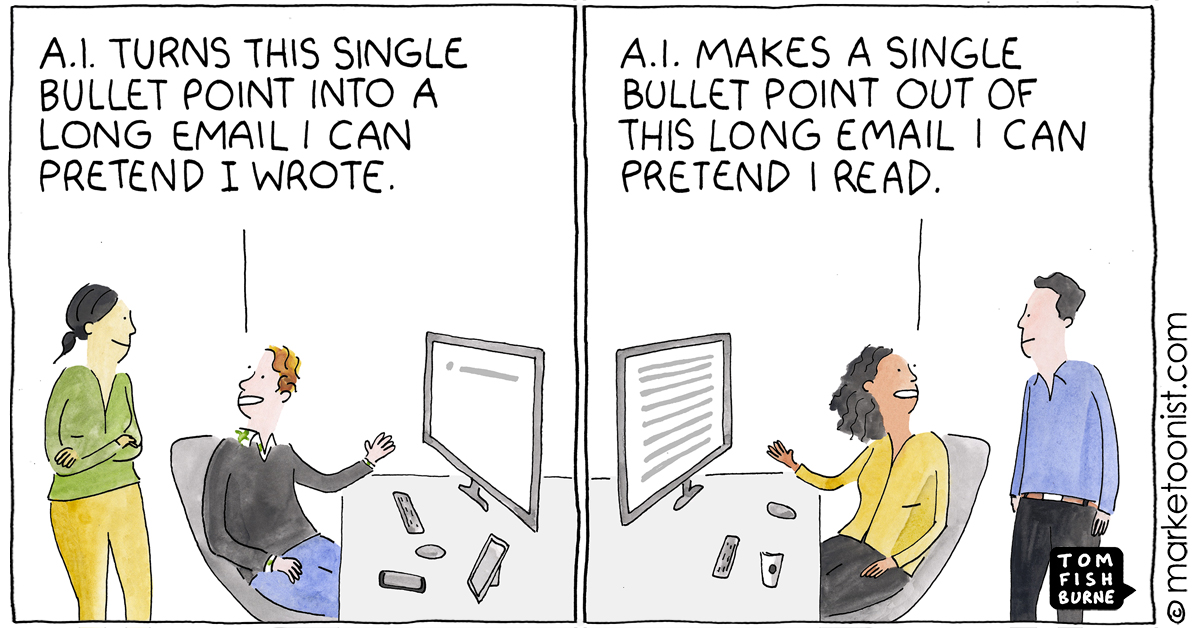
Someone forwarded an enormous amount of text over teams the other day at work. From someone (bless her) that always means well but usually averages about one spelling mistake per word and rarely goes over 20 words per message. Clearly copy paste chatgpt.
For say hn gang that thinks in terms of context shifts, information load and things on THAT wave length the problem with that situation is obvious but I realised then that is not at all obvious to the average public. She genuinely seemed to think she's helping me by spending 15 seconds typing in a prompt and having me spend the next 30 minutes untangling the AI slop.
There is zero understanding or consensus of acceptable practices around that sort of thing baked into societal norms right now.