I've been reading The Economist for well over thirty years. In England I think it's clearly identified as a paper of the right. (Correct me if I'm mistaken.)
The only reason it might not be seen as right wing in the US, is that the right wing here is so batsh*t crazy: Banning abortion and birth control, blaming gay people for earthquakes, carrying assault rifles around in public, genuinely believing that the world is 6000 years old - these are not part of educated discourse in the rest of the OECD.
Do you actually doubt that happens? See Texas in recent national news with abortion. Pushback on Roe vs Wade is unceasing, they have nothing to lose (except their time and money, and they have plenty of both) by hammering away at it, no matter how little ground they gain, so that is exactly what they do.
And if you don't think that young earth creationism is a popular belief in America, then you have obviously been exposed to a very small sliver of American society.
Stricter laws but much better access. If you can get a government-subsidized first-trimester abortion at a nearby clinic, it makes the availability of late-term abortions much less politically contentious. That's not a compromise that's really available in the US, mostly because it would require universal health care first.
But two replies to refurb's comment and both ignore the matter at hand in order to change the conversation in a new direction.
The matter at hand here is whether or not it would be considered breaking the law to abort a fetus, not how that process is financed or whether the population understands that intercourse can lead to pregnancy.
And in that matter—legality of abortion—refurb was pointed out that the US is not necessarily less "free" than elsewhere. I think the point still stands.
This is the same US that has people making abortion a felony offence and calling it feticide, right? Or that have laws granting rights at the point of inception?
There is a single abortion clinic in the state of Mississippi; a state with roughly the population of Wales, but six times the area.
Yeah, the Catholic Church has done a number on a few European countries, but nobody here is holding up the state of abortion in Ireland as something that should be aspired to.
Most of Europe also has far more comprehensive sex education and available of birth control than the US, and subsequently far less demand for abortions.
White women abortion rate is equivalent to Europe (11 per 1k), Black women abortion rate is 50 (Hispanics as usual are in the middle - 28). Given that sex education & birth control are not distributed by ethnicity, there must be more to it than that.
That could well be a religions/cultural difference. I would not be surprised if mostly-white parts of the US with poor sex education have higher rates of unplanned births (than Europe), rather than abortions.
I am sure it is a cultural difference - but not wrt abortion but marriage.
"In 2011 , 72 percent of all births to black women, 66 percent to American Indian or Alaskan native women, and 53 percent to Hispanic women occurred outside of marriage, compared with 29 percent for white women, and 17 percent for Asian or Pacific Islander women."
" Since 1982, between 40% and 50% of adults in the United States say they hold the creationist view that 'God created humans in their present form at one time within the last 10,000 years'. "
I don't know a thing about religion or theology, so take this with a huge grain of salt.
But I still don't really buy the accuracy of these numbers for the matter at hand here. I suspect that when asked by a pollster, someone who answers affirmative to this question is doing so because their religion has told them to believe that.
The pollster probably doesn't ask a follow-up question of the form, "C'mon, really?" I suspect the answer would often be, "Yeah, not really. But the priest/minister/religion-dude/whatever says it a whole bunch, plus it's in that book we are forced to read over and over."
People like to have their pet beliefs that they know to be factually incorrect. I like to believe my taste in music is superior to just about everyone else's. But it's not.
Apologies for my sacrilege here if you are religious.
> The pollster probably doesn't ask a follow-up question of the form, "C'mon, really?" I suspect the answer would often be, "Yeah, not really. But the priest/minister/religion-dude/whatever says it a whole bunch, plus it's in that book we are forced to read over and over."
Yes, if the pollster started bullying people who answered one way, that would probably warp the results... those polls are performed by polling organizations that are well regarded because they don't try to warp their polling results like that.
The mere fact that so many Americans would answer that way, even if they didn't honestly believe it 6 days out of the week, is 1) notable, 2) disturbing.
A bit nitpicking but that's a different statement than saying the earth is 6,000 years old. "Humans in their present form" is a very vague statement. You could take it to mean god imparted the knowledge of agriculture upon humans which had a hugely transformative effect on mankind which made modern humans what they are today. Or you could say god imparted the biblical knowledge of right and wrong and that allowed humans to become what they are today. Hell, it could even be interpreted as true by evolution believing religious people with a poor understanding of the timescales evolution operates over.
I'm very skeptical of the idea that around half of the people around me think the existence of the earth or humans are less than 10,000 years old and I live in an extremely religious state (Utah). Mormons aren't known for being creationists though so perhaps my personal experience is unusual.
So, yes, while there will be a fair bit of overlap between those who answered "created in their present from in the last 10,000 years" and those who believe the earth is less than 6,000 years old, the questions are not equivalent.
That’s essentially the day-age view, and surprisingly few creationists subscribe to that (and no young earth creationists do so). It doesn’t change that even if you believe in day-age creationism, you’re accepting something that has no more basis in reality than the various creation tales in the Vedas do.
Also, abortion is continually made more difficult to get by many states, going as far as regulating it out of the state.
One state has one clinic in its entirety, and they are doing everything they can politically to get them out.
Abstinence based education is another notch in the belt of "its legal, but we are going to do our damndest to ruin it" and you can see skyrocketing aids infections in countries where the united states only provided funding if they taught abstinence.
Even if living wage is bad economic policy, it does not belong in the same category as young-earth creationism or eco-terrorism.
While there is a left fringe, they have effectively zero influence on national policy, whereas the mainstream right absolutely pays attention (or at least lip service) to their fringe. Compare how often mainstream Republicans discuss Limbaugh or Beck to how often Democrats bring up Chomsky or Moore. Outside of Berkley, the latter simply doesn't happen.
Bad economic policies such as living wage laws actually do get enacted into law (mostly at the state and local level) and thereby make people's lives worse. Laws like that prevent people from employment, restrict economic growth, destroy economic opportunity.
Whereas people claiming to believe in young-earth creationism has no real policy ramifications - it doesn't actually MATTER.
(Though for left-wing crazy I think would have proposed anti-GMO, anti-vaccine, anti-fracking, anti-growth, anti-technology in general.)
Maybe. We already have a lesser form of living wage in the form of minimum wage. The merits of either are debatable; I might disagree, but I wouldn't deem anyone crazy for taking either position.
However, genuinely believing that the earth is 6,000 years old is not an idea that should be taken seriously, any more than believing the earth is flat (or anti-vaccination).
Tolerating willful ignorance of science has cultural ripple effects across all sorts of policy issues, from sex education, to common-sense environmental debate, to critical thinking skills, civics, and political discourse. It arguably matters more than anything.
Seriously though, if you're determined to doubt the law of demand applies to the market for labor - as I suspect you are - then Don Boudreaux has some questions for you:
(I can of course give specific EXAMPLES of people being denied work they would like (and that their employer would like to give them) because their productivity is too low to justify the minimum wage, but I suspect you'd just dismiss that as "anecdotal evidence". Is that what you want to see? Or if not, what would "data that explicitly shows this causation" have to look like for you to find it relevant?)
Oh, and if you decide correlation data might be acceptable, I'd start with this report:
(TLDR: in 2007 it was attempted to gradually bring the minimum wage in American Samoa up to the level in the rest of the US. The resulting hit on employment levels was truly impressive and hard to explain any other way than that setting the wage level above the market level destroyed jobs.)
>what would "data that explicitly shows this causation" have to look like for you to find it relevant?
I'm not sure, because I don't think anyone's found any. The american samoa link is interesting, and it certainly looks like employment took a hit for it. But how comparable is American Samoa's economy, to, say, Washington DC or Birmingham Alabama?
I assume they're all comparable in the relevant attribute which is: if you make labor more expensive, employers will tend to consume less labor. Do you have some reason to think they're not comparable in that way? Do we need to find evidence of a general economic principle in EVERY locality for you to accept that it is, in fact, a general economic principle? Or is it sufficient that we have a strong intuitive argument and hundreds of studies showing it in action in various places and times? (And if you think the difference is "monopsony" as per Card/Kruger, how do you answer Boudreaux's questions I linked above?)
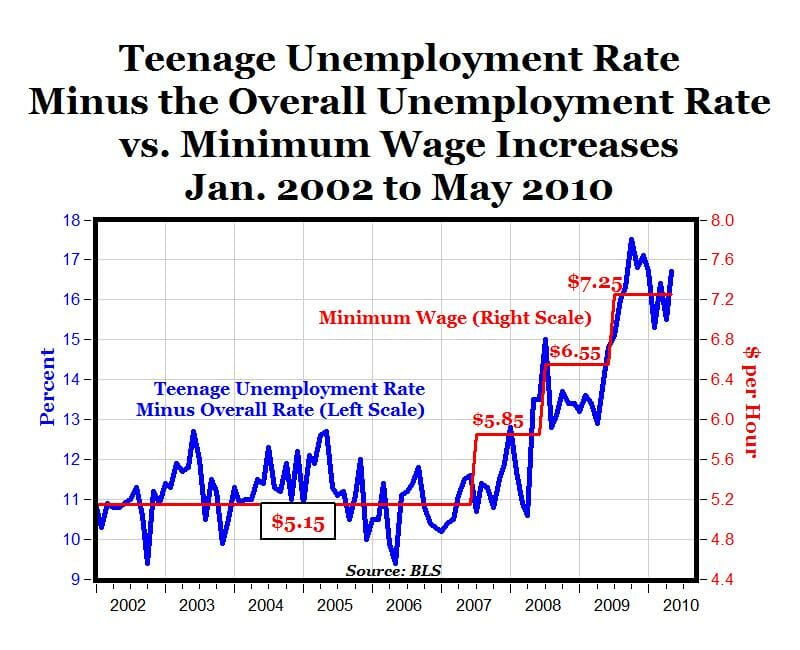
In the US, here's a plot of the correspondence between the teenage unemployment rate and recent large minimum wage rate hikes:
Quote: "Each 10% increase in the minimum wage [since 2007] was accompanied by a decrease in employment of 1.2% for Hispanic males, 2.5% for white males and 6.5% for black males. When looking at hours worked, we saw a similar effect: Each 10% increase in the minimum wage reduced hours worked by 1.7% for Hispanic males, 3% for white males and 6.6% for black males.
The data clearly show a disproportionate loss of hours and employment for black young adults. Let's put these lost opportunities into context. Between 2007 and 2010, employment for 16- to 24-year-old black males fell by approximately 34,300 as a result of the recession; over the same time period, approximately 26,400 lost their jobs as a result of increases in the minimum wage across the 50 states and at the federal level." (source: http://mjperry.blogspot.com/2011/07/second-recession-from-mi... )
It's more complicated than that: on the issues that are most controversial in the USA, it's true that other countries have what looks like a consensus by comparison. But other countries have their own issues that make Republicans look positively enlightened: see, for instance, many European countries' right-wing edge of opinion on immigration and diversity.
Sure, conservatives get bad in the States--see the attempt to block building a mosque in Tennessee by a bunch of drooling rednecks--but look at things comparatively. In Switzerland, they banned building mosques anywhere in the country. In France, they (successfully?) tried to regulate what clothing Muslim women can wear in public. And even those countries are relatively enlightened for Europe: try being an immigrant in Greece or gay in Russia.
The difference is that in Europe, the entire spectrum is much more visible because they come in separate parties.
And yes, you'll find lots of nutjobs, but overall, across Europe, for the most part those nutjobs are now marginalised one or two parties to the right of the mainstream right wing parties, whereas in the US the centre of gravity in terms of votes fall far closer to them.
(Btw. you bring up another interesting point: To most people in the Western parts of Europe, parts of Russia might be geographically Europe, but we don't tend to include it when talking about Europe; the same often goes for countries like Ukraine - I know I didn't even consider either of them when using the term Europe earlier)
Definitely, but a prevailing view amongst many HNers is that the world is the United States[1], so it was more about challenging that assumption than anything else.


The only reason it might not be seen as right wing in the US, is that the right wing here is so batsh*t crazy: Banning abortion and birth control, blaming gay people for earthquakes, carrying assault rifles around in public, genuinely believing that the world is 6000 years old - these are not part of educated discourse in the rest of the OECD.